

In today’s competitive landscape, businesses are constantly searching for a sustainable edge. One of the most powerful—and often overlooked—assets an organization possesses is a highly engaged workforce. Employee engagement is much more than just a fleeting trend; it is a critical measure of the relationship between an organization and its employees. Understanding and actively improving employee engagement strategies is essential for business success, high performance, and long-term sustainability.
What is Employee Engagement?
Employee engagement can be defined as the emotional and cognitive connection an employee feels toward their work, team, and organization. It’s the level of commitment, enthusiasm, and dedication an employee brings to their job. An engaged employee isn’t just “satisfied” or “happy”—they are fully invested in the organization’s mission, values, and overall success. This connection manifests as discretionary effort—the willingness to consistently go above and beyond the minimum requirements of their role. True engagement encompasses three key dimensions:
- Intellectual Engagement (thinking about how to do the job better)
- Emotional Engagement (caring about the company and its goals)
- Social Engagement (actively discussing and supporting the organization)
The Importance of Employee Engagement

Prioritizing employee engagement is not just a feel-good HR initiative; it is a fundamental driver of business outcomes. When employees are highly engaged, they take greater ownership of their work and become organic advocates for the company. This commitment directly translates into superior organizational performance. Research consistently shows a direct correlation between high engagement levels and metrics like increased productivity, improved service quality, and better customer satisfaction. It is the core mechanism that turns a group of individual workers into a high-functioning, resilient team capable of navigating change and driving innovation. Furthermore, in a highly competitive talent market, a strong focus on engagement is crucial for talent retention and reducing employee turnover.
Factors That Influence Employee Engagement
Several interconnected factors determine an employee’s level of engagement, all of which fall under the umbrella of the employee experience.
- The effectiveness of organizational leadership is a major driver, as leaders must consistently communicate a clear vision, provide support, and demonstrate empathy.
- Opportunities for Growth and Development are equally critical; employees are more engaged when they see a clear career path and are given resources for professional development and skill-building.
- The culture of recognition and appreciation also profoundly impacts engagement—employees need to feel valued for their contributions, not just their presence.
- Other vital factors include work-life balance and flexibility, clear and open internal communication, and a sense of meaning or purpose in their work, ensuring employees understand how their daily tasks contribute to the company’s bigger picture.
The Levels of Employee Engagement
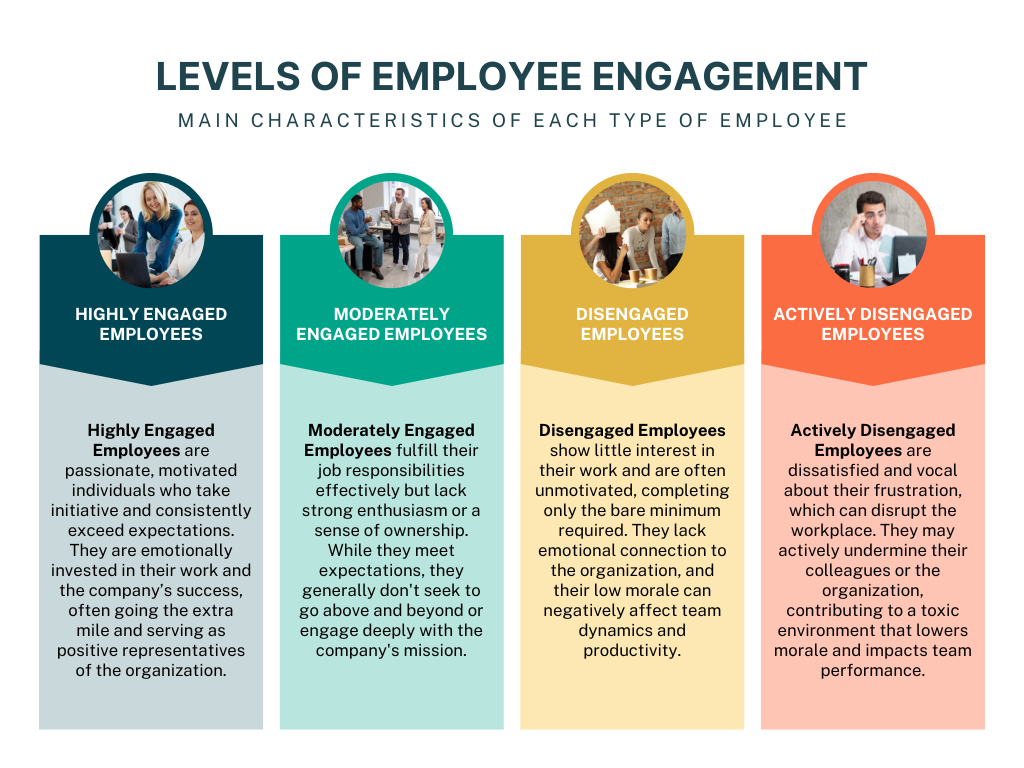
Understanding the different levels of engagement is crucial for managers seeking to improve their teams. Most models categorize employees into three primary groups, but I like to think there’s a fourth category: Highly Engaged.
The traditional model places Actively Engaged employees as the ideal—they are passionate, committed, enthusiastic, and actively drive performance and innovation. They are the company’s strongest advocates. However, Highly Engaged employees represent an even higher tier; they are the true innovators, mentors, and culture-builders who not only drive their own performance but actively elevate those around them, often serving as informal leaders.
The second group is Disengaged employees. These individuals are typically satisfied but perform only the minimum required. They show up, do their their tasks, and collect a paycheck, but they lack the emotional commitment and discretionary effort to help the organization improve. The third and most detrimental group is Actively Disengaged employees. These individuals are unhappy, resentful, and often undermine the efforts of their engaged coworkers.
A key strategy for leaders is to identify the ‘Disengaged’ segment—the largest group in many organizations—and implement targeted engagement initiatives to move them into the Actively Engaged and ultimately the Highly Engaged categories.
Employee engagement is far more than a corporate buzzword; it is a measurable business strategy that fuels sustainable growth and competitive advantage. Investing in your employee’s connection to their work is the single most effective way to boost organizational performance, enhance talent retention, and build a resilient, successful future. The question for every leader is not if you can afford to focus on engagement, but rather, can you afford not to?
You Might Also Enjoy:




 EA and Beyond
Leave a comment