

Do you ever stare at your to-do list and have no idea where to start? You’re not alone. Many people struggle with deciding which tasks deserve their attention first. The good news is that there’s a simple tool that can help you figure this out in minutes. It’s called the Eisenhower Matrix, and learning how to use it can completely change how you work.
What is the Eisenhower Matrix?
The Eisenhower Matrix is a time management tool that helps you organize your tasks into four categories. It’s named after President Dwight D. Eisenhower, who was known for being incredibly productive. He once said that he had two types of problems: urgent ones and important ones. He noticed that the urgent problems were rarely important, and the important problems were rarely urgent.
This observation became the foundation for a simple grid that millions of people now use to manage their time better. The matrix is just a square divided into four boxes, and each box tells you what to do with different types of tasks.
How to Use the Eisenhower Matrix: The Basic Setup
To start using the Eisenhower Matrix, you need to understand two key concepts: urgency and importance.
Urgent tasks need to be done right away. They have deadlines that are coming up soon, or they require immediate action. Think of these as tasks that are screaming for your attention.
Important tasks help you reach your long-term goals. They contribute to your success, health, or happiness. These tasks matter for your future, even if they don’t need to be done today.
Once you understand these two ideas, you can sort every task on your to-do list into one of four boxes.
The Four Boxes: How to Use the Eisenhower Matrix for Every Task
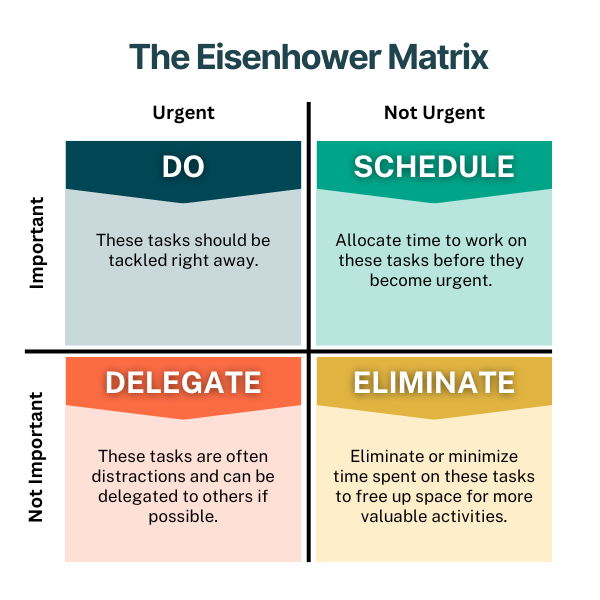
Box 1: Do It Now (Urgent AND Important)
These tasks are both pressing and meaningful. They need your immediate attention because they matter for your goals and they can’t wait.
What to do: Drop everything and handle these tasks first.
Examples:
- A project due tomorrow that affects your grade or job
- A medical emergency
- Fixing your car when you need it to get to work
- Responding to a time-sensitive email from your boss
Pro tip: If you find yourself spending all your time in this box, you’re always in crisis mode. The goal is to have fewer tasks here by planning better.
Box 2: Schedule It (Important but NOT Urgent)
This is the most important box for long-term success. These tasks will improve your life and help you reach your goals, but they don’t have a deadline staring you in the face. Because of this, people often ignore them until they become urgent.
What to do: Put these tasks on your calendar with specific dates and times. Treat these appointments with yourself as seriously as you would a meeting with someone else.
Examples:
- Studying for a test that’s two weeks away
- Exercising and meal planning
- Learning a new skill for your career
- Having important conversations with family or friends
- Planning a major project before it becomes urgent
- Saving money or reviewing your budget
Pro tip: Successful people spend most of their time in Box 2. When you focus here, you prevent crises before they happen.
Box 3: Delegate It (Urgent but NOT Important)
These tasks feel like they need to be done right away, but they don’t actually help you reach your goals. They’re often things that interrupt you or that someone else could handle just as well.
What to do: Give these tasks to someone else if possible. If you can’t delegate them, do them quickly and move on. Don’t let them take up too much of your day.
Examples:
- Answering phone calls that could go to voicemail
- Responding to group chat messages that don’t need your input
- Attending meetings that don’t require your presence
- Running errands that a family member could do
- Handling small requests from coworkers
Pro tip: Many people struggle with this box because these tasks feel urgent. Remember, just because something feels pressing doesn’t mean it’s important to YOUR goals.
Box 4: Delete It (NOT Urgent and NOT Important)
These are time-wasters. They don’t help you reach your goals, and they don’t need to be done anytime soon (or ever). These activities just fill up your time and distract you from what matters.
What to do: Stop doing these things. Remove them from your to-do list completely.
Examples:
- Scrolling through social media for hours
- Watching TV shows you don’t even enjoy
- Playing mobile games that you do out of habit
- Reorganizing things that are already organized
- Reading every email newsletter you’ve signed up for
Pro tip: Be honest with yourself about these activities. We all have them. Cutting them out frees up time for Box 2 tasks.
Step-by-Step: How to Use the Eisenhower Matrix Today
Ready to put this into practice? Here’s exactly how to use the Eisenhower Matrix right now:
Step 1: Make a list of everything you need to do. Write down every task, big or small. Don’t worry about order yet.
Step 2: Draw your matrix. Take a piece of paper and draw a large square. Divide it into four equal boxes. Label them with the four categories.
Step 3: Sort each task. Go through your list one item at a time. Ask yourself two questions: “Is this urgent?” and “Is this important?” Based on your answers, place each task in the correct box.
Step 4: Take action based on the box. Handle Box 1 tasks immediately. Schedule Box 2 tasks on your calendar. Delegate or minimize Box 3 tasks. Delete Box 4 tasks.
Step 5: Review regularly. Tasks can move between boxes as deadlines approach. Check your matrix daily or weekly to keep it updated.
Common Mistakes When Learning How to Use the Eisenhower Matrix
Even after you understand the basics, it’s easy to make these mistakes:
Mistake 1: Putting too many tasks in Box 1. If everything feels urgent and important, you’re not being honest about true priorities. Most tasks belong in other boxes.
Mistake 2: Ignoring Box 2. This happens when you only focus on what’s urgent. Remember, Box 2 is where real progress happens.
Mistake 3: Feeling guilty about Box 4. It’s okay to have some downtime and fun. Box 4 is for activities that are truly wasteful, not healthy relaxation.
Mistake 4: Not actually delegating Box 3 tasks. You have to follow through. If you identify something to delegate but then do it yourself anyway, you’re defeating the purpose.
Why Learning How to Use the Eisenhower Matrix Changes Everything
When you master this tool, several things happen:
You feel less overwhelmed. Instead of facing a giant to-do list, you have a clear plan of attack.
You make better decisions. You stop wasting energy on things that don’t matter.
You accomplish more. By focusing on important tasks before they become urgent, you work more efficiently.
You reduce stress. Fewer last-minute crises mean a calmer, more controlled life.
You achieve your long-term goals. Spending time in Box 2 means you’re always moving toward what you want in life.
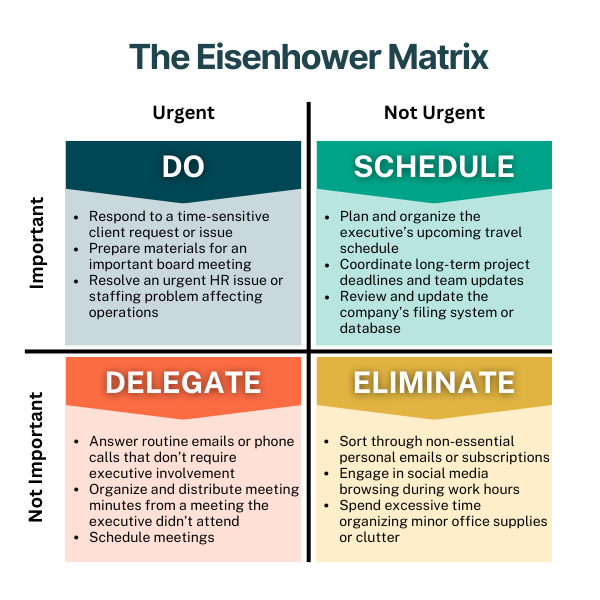
Real-Life Example: How to Use the Eisenhower Matrix as an Executive Assistant
Let’s say you’re an executive assistant supporting a busy executive. Here’s what your matrix might look like:
Box 1 (Do Now): Preparing materials for a meeting that starts in one hour, handling an urgent travel change for tomorrow’s trip, responding to a time-sensitive client request, fixing a scheduling conflict that affects today’s agenda.
Box 2 (Schedule): Planning next quarter’s board meeting, organizing the executive’s professional development goals, building relationships with key stakeholders, creating systems to streamline recurring tasks, reviewing and updating contact databases.
Box 3 (Delegate): Having the office manager order supplies, asking IT to handle a technical issue, forwarding routine inquiries to the appropriate department, letting junior staff coordinate basic meeting logistics.
Box 4 (Delete): Checking email every five minutes instead of at set times, attending meetings where you’re just an observer, reorganizing files that are already functional, responding to every non-urgent message immediately.
Tips for Making the Eisenhower Matrix Work for You
Use it every morning. Spend five minutes sorting your tasks before you start your day.
Be ruthless with Box 4. Really eliminate these activities. They’re stealing time from your goals.
Protect your Box 2 time. Put it on your calendar like an appointment. This is the most important habit you can build.
Review what’s working. After a week, look back. Did you spend more time in Box 2? Did you have fewer Box 1 crises? Adjust your approach as needed.
Keep it simple. Don’t overcomplicate the system. The power of the Eisenhower Matrix is in its simplicity.
Your Next Step
Now that you know how to use the Eisenhower Matrix, the only thing left is to actually use it. Grab a piece of paper right now and draw your four boxes. Write down everything you need to do today and sort it. Then take action on what ends up in Box 1, schedule what’s in Box 2, delegate Box 3, and delete Box 4.
The difference between successful people and everyone else often comes down to how they spend their time. The Eisenhower Matrix gives you a clear way to invest your time in what truly matters. Start using it today, and you’ll be amazed at how much more you can accomplish with less stress.
You Might Also Enjoy:




 EA and Beyond
Leave a comment